Category: Uncategorized

  • Sick of Power Bills? How I Turned My Roof into a Little Earner (Solar in NZ)

    Cheers everyone! 🖐️

    With power prices in New Zealand climbing faster than ever, many of us are looking at our monthly bills and wondering if there’s a better way. We all love the idea of being “green,” but let’s be honest: at the end of the day, it has to make financial sense for your household.

    After crunching the numbers and seeing the results, I’ve realized that Solar Panels aren’t just an environmental choice—they are a strategic financial asset. Here is how solar actually generates an income and why it might be the smartest move for your home in 2026.

    💰 1. Direct Savings: The “Invisible” Income

    The most immediate way solar “pays” you is by slashing your outgoing expenses. In New Zealand, the average cost of grid power is around 30c to 40c per kWh.

    • Self-Consumption: Every unit of electricity your panels produce and you use (to run the dryer, heat the water, or charge the EV) is money that stays in your pocket.
    • Daily Habit Shift: By simply shifting high-energy tasks to the middle of the day when the sun is brightest, you are essentially getting your power for free.
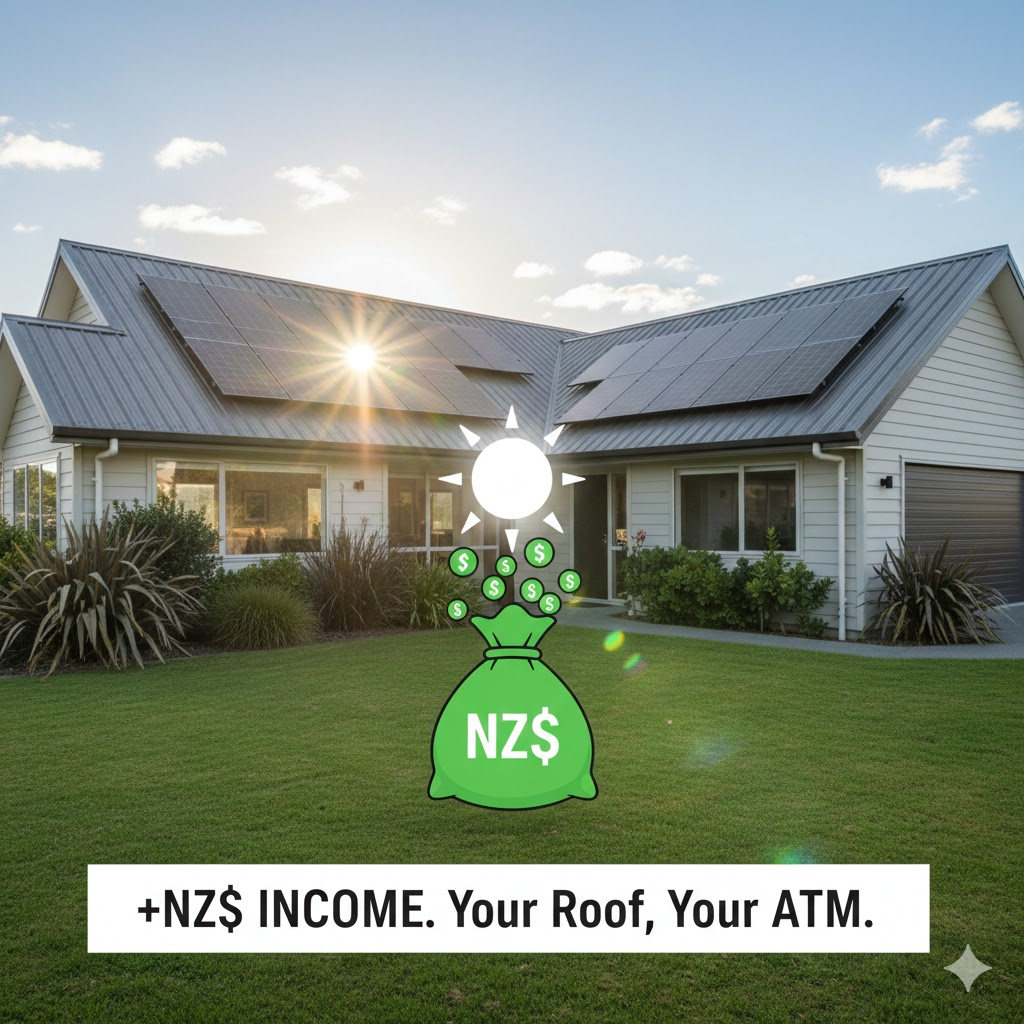
    📈 2. Export Tariffs: Getting Paid by the Grid

    When your house is empty during the day, your roof is still working. That excess energy doesn’t go to waste; it gets fed back into the national grid.

    • The Buy-back Rate: Power companies in NZ (like Octopus Energy, Meridian, or Contact) will buy that excess power from you.
    • Passive Credit: Depending on your provider, you can earn anywhere from 12c to 17c per kWh. While this is lower than the retail price, seeing a “Credit” on your bill instead of a “Total Due” feels like a genuine win against the system.

    🏦 3. Using the Bank’s Money to Build Wealth

    One of the most persuasive reasons to go solar right now is the support from NZ banks.

    • Low-Interest Loans: Banks like ANZ, ASB, and Westpac offer energy-efficiency loans at incredibly low rates (often around 1% for 3 years).

    The Math: * Your monthly loan repayment: ~$60 (for a $12k system).

    • Your monthly power savings: ~$200 – $250.
    • The Result: You are +$140 to $190 in profit every single month from day one.

    The ROI: This is a 15% – 20% annual return, tax-free. No Term Deposit in NZ can beat that.

    🤔 “But is NZ sunny enough?”

    A common misconception is that you need tropical weather. New Zealand’s high UV levels mean our panels are incredibly efficient, even on cooler days. While production drops in winter, the massive summer credits often offset those colder months.


    💬 The Final Verdict

    Going solar isn’t about “saving the world” overnight; it’s about taking control of your largest utility bill and turning a passive roof into a productive income-earner.

    Are you still waiting for power prices to drop, or are you ready to start making the grid work for you? Let me know your thoughts in the comments!

    Catch you later! 👋
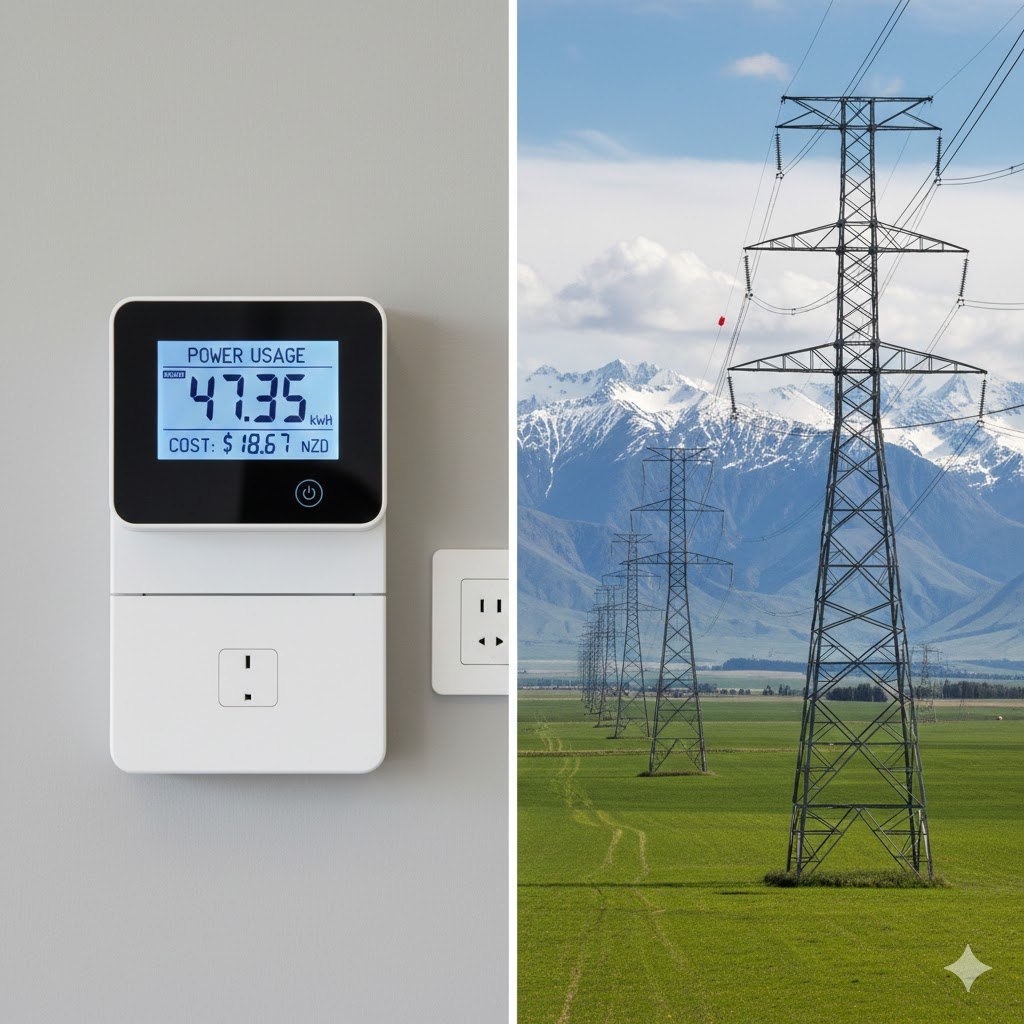
  • Ask me: Why is My Electricity Bill So High? NZ Power Guide 2026

    We all know the feeling: you open your power app, see the monthly total, and think, “Wait, I haven’t even turned the heater on yet!”

    In 2026, staying on top of power bills in NZ feels like a full-time job. Whether you’re a family of four in Auckland or living rural in Northland, the price gap can be a brutal $500 difference a year—even if your habits haven’t changed at all.

    If you’re tired of the ‘Post-Winter Bill Shock’ or just sick of paying the ‘regional tax,’ let’s look at why your location is hitting your wallet so hard and how you can actually fight back.

    Location, Location, Location!

    Why does a coffee in Auckland cost the same as in Wellington, but electricity doesn’t? It all comes down to Lines Charges (the cost of delivering power to your door).

    • The City Advantage (Auckland & Wellington): High population density means more people share the cost of maintaining the poles and wires. This usually makes power cheaper in big cities.
    • The Rural Reality (Northland & West Coast): Sending power through rugged mountains or long stretches of farmland is expensive. If fewer houses are connected to a long line, each household pays more.
    • Distance from the Source: Most of our power is generated in the South Island (Hydro) or Central North Island (Geothermal). The further the “delivery” journey, the higher the cost.

    📊 NZ Power Rates: Auckland vs Regions (As of Feb 18, 2026)

    Region Avg. Rate (per kWh)Price LevelMonthly Est. (Family of 4)
    Wellington~34.7cLow$250 – $290
    Auckland Central~38.2cMid$280 – $350
    Hamilton~37.3cMid$270 – $330
    Christchurch~35.7cLow$260 – $310
    Northland (Kerikeri)~48.4cHigh$450 – $550

    The Heat Pump Mystery: Cooling vs. Heating

    Looking at those monthly estimates above, you might be wondering: “Will using my Heat Pump as an AC in summer ruin my budget?” The short answer is: No. In fact, cooling your home in a Kiwi summer is a bargain compared to the winter struggle. Here’s why the cost feels so different:

    • Summer Cooling: Typically, you’re only dropping the temperature by 5-7°C (e.g., from 27°C down to 20°C). It’s an easy job for a modern unit, and the power consumption is relatively low.
    • Winter Heating: This is where the bill shock happens. Your heat pump has to work overtime to pull warmth from the 5°C outside air to reach a cozy 20°C inside. That’s a 15°C jump!

    My Golden Rule: If you’re still using those old-school plug-in fan heaters or oil columns, stop immediately. They can use up to 3 times more electricity than a heat pump to produce the same amount of heat. Set your heat pump to a steady 18-20°C and leave it—constant switching on and off actually uses more power.

    💡Top Tips to Slash Your NZ Power Bill

    1. Low User vs. Standard User: The “Family of 4” Trap

    • Low User: Best for small households (1-2 people). Lower daily fee, but higher price per unit.
    • Standard User: The winner for a family of 4. You pay a higher daily fee, but the price per unit (kWh) is much lower. If your bill is consistently over $180/month, make sure you are on a Standard Plan.

    2. Master the “Peak” Game ⏰

    Most NZ providers use Time-of-Use (TOU) pricing. Electricity is expensive when everyone else is awake.

    • Peak Times: 7 AM – 9 AM & 5 PM – 9 PM (Most expensive)
    • Off-Peak: 9 PM – 7 AM (Much cheaper)
    • My Pro Tip: I never run the dishwasher or dryer before 9 PM. Set the “Delay Start” timer to run at midnight—you’ll save money while you sleep!

    3. The “Power + Gas” Bundle Hack 🎁

    Don’t pay two different companies. Bundling services like Gas + Power or Broadband + Power can trigger “Multi-saver” discounts. Companies like Mercury or Contact often offer $150–$300 credits for bundling.

    4. The “Hour of Power” & Dehumidifiers

    • Electric Kiwi: Offers 60 mins of free power daily. Coordinate all your laundry for that one hour!
    • The Dehumidifier Trick: NZ houses can be damp. A dry house warms up 20% faster, making your heater much more effective and cheaper to run.

    Final Thoughts

    Saving on electricity in NZ isn’t about sitting in the dark; it’s about timing and plan choice. Before you sign a long-term contract, check your local lines company and use Powerswitch.org.nz at least once a year to ensure you’re on the best deal.

    Check out my NZ Grocery Price Guide 2026

  • Is New World Actually More Expensive? A 2026 Price Comparison for NZ Shoppers

    When it comes to grocery shopping in New Zealand, the general perception is that New World is the “premium” (and therefore expensive) choice, while Pak’nSave is the king of low prices. But in 2026, with shifting costs and club card deals, is this still 100% true?

    I decided to do a real-time price comparison to see how much of a “premium” you’re actually paying at New World compared to Woolworths and Pak’nSave.

    The Results: New World vs. Woolworths vs. Pak’nSave

    To keep it fair, I compared the same 10 everyday essential items. Here is how the mid-February 2026 prices look:

    Item New WorldWoolworthsPak’nSave
    1kg Royal Gala Apples$4.49$4.35$2.79
    1L Standard Milk$2.98$2.98$2.96
    1kg Standard Flour$3.79$3.79$2.79
    Dozen Eggs (Size 7)$10.09$8.99$7.29
    500g Butter$8.89$8.00$7.69
    White Toast Bread$3.20$3.10$2.99
    1kg Chicken Breast$17.99$16.90$10.89
    Bagged Iceberg Lettuce$4.50$4.75$3.99
    Can Chopped Tomatoes$1.99$1.99$1.89
    Weet-Bix 1.2kg$9.49$9.49$6.49
    Total Basket Cost$66.58$62.43$50.71

    New World supermarket price comparison

    Key Insights: What These Numbers Tell Us

    1. The “Experience” Premium at New World

    While the total at New World was the highest at $66.58, the difference isn’t just about the price tag. New World stands out for its enhanced shopping experience. They place a significant emphasis on their presentation, making the aisles feel more like a premium market rather than a high-volume bulk store. For many, the cleaner layout and shorter queues justify the extra few dollars.

    2. Quality and Seasonality

    When shopping at New World, it’s worth looking out for their “in-season” specialties. During this visit, the fresh stone fruits and local Royal Gala apples were at their peak quality. Often, the freshness and curated selection at New World or Woolworths offer a balanced “middle ground” for shoppers who value quality over the absolute lowest price.

    3. Pak’nSave Still Leads on Value

    There is no denying that Pak’nSave remains the leader for bulk savings, coming in at $50.71—nearly $16 cheaper than New World. If your primary goal is to minimize your weekly grocery bill, the “no-frills” warehouse style is still the way to go.

    Final Verdict

    If you are a budget-conscious shopper with a large family, Pak’nSave is the clear winner. However, if you prefer a curated shopping environment and high-quality in-season produce, New World remains a strong contender, provided you keep an eye on their Club Card specials.